
How I Automated Casino Game Onboarding with AI and Custom Extensions
How a five-part automation pipeline — spanning AI-assisted configuration, OCR asset renaming, browser automation, and certificate processing — eliminated hours of weekly manual work and freed up time for higher-value strategic work.
Working as a casino manager, one of our key operational priorities was scaling the variety of games available on site. The challenge was not sourcing content — it was the release process itself. Configuring, onboarding, and publishing each new game involved a significant volume of manual, repetitive work: data entry, file management, form submission, and document processing. At its worst, this consumed the better part of a working day each week.
Over time, I built a connected set of tools to automate each stage of that process. What follows is an account of how each tool came to exist, what problem it solved, and what became possible once the manual overhead was removed.
Phase 1: From Manual Entry to Bulk CSV Import
The starting point was the CMS itself. Initially, every new game had to be configured individually — a slow, error-prone process of filling in fields one at a time. The first meaningful improvement came when I discovered the CMS supported bulk game creation via CSV upload.
I began by exporting our game pipeline from Monday.com and reformatting it into the required CSV structure in Excel. It was a significant step forward, but it remained a largely manual process — the mapping of fields, handling of constants, and formatting had to be done by hand each time.
Phase 2: AI-Assisted Game Configuration
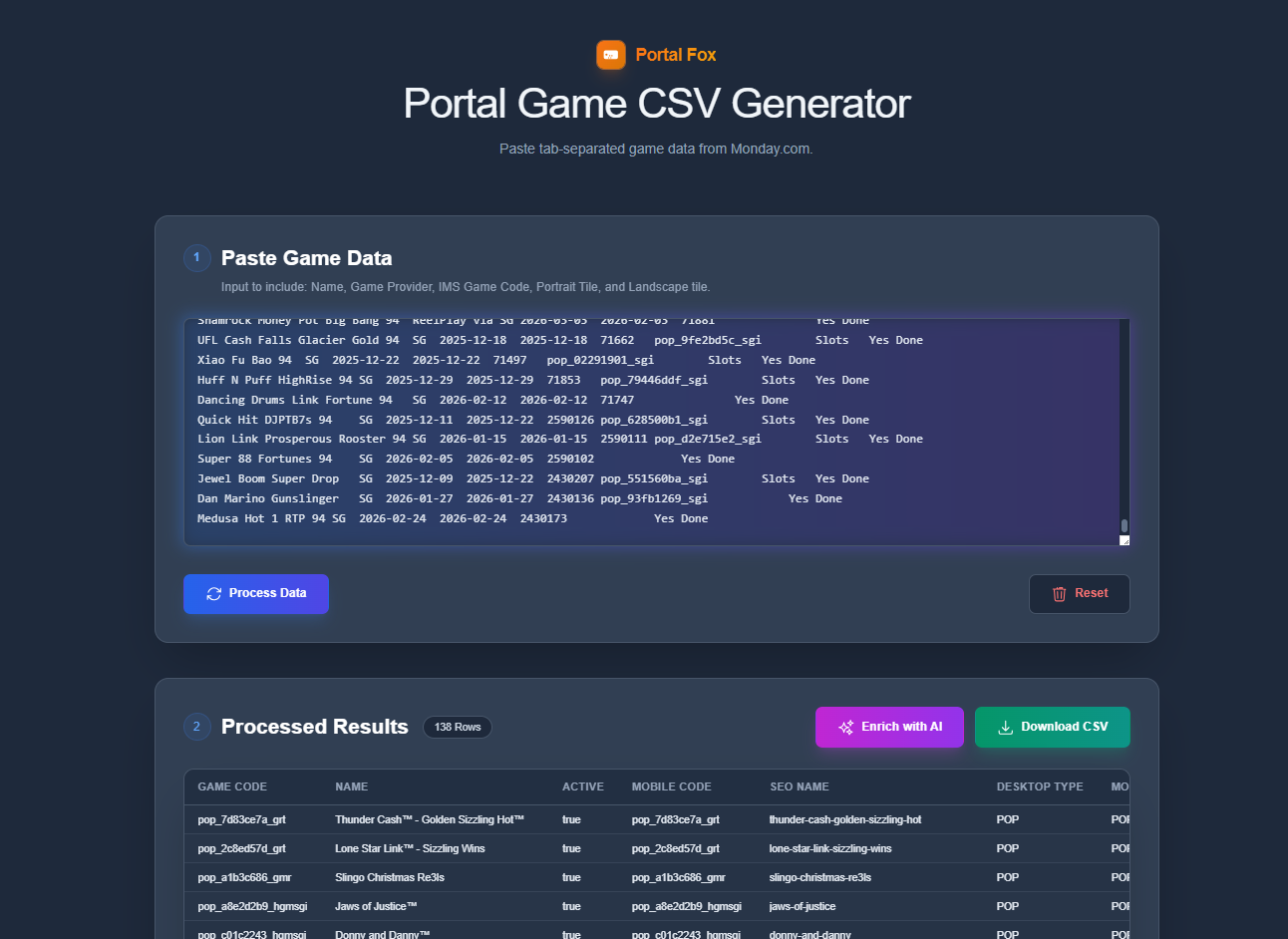
To remove the remaining manual effort from the CSV preparation stage, I built a dedicated application. The tool accepted a Monday.com board export directly and handled all field mapping and constant population automatically. More significantly, it integrated AI to populate game metadata — including theme, style, number of reels, and feature classifications — fields that had previously required manual research and entry for each title.
The result was a process that went from a time-consuming formatting exercise to a near-instant export, with richer data than had been practical to produce manually.
Phase 3: Automated Game Asset Renaming
In parallel with the configuration work, we were launching a new frontend that required game tiles in two aspect ratios: portrait and square. This immediately doubled the volume of assets to manage per release.
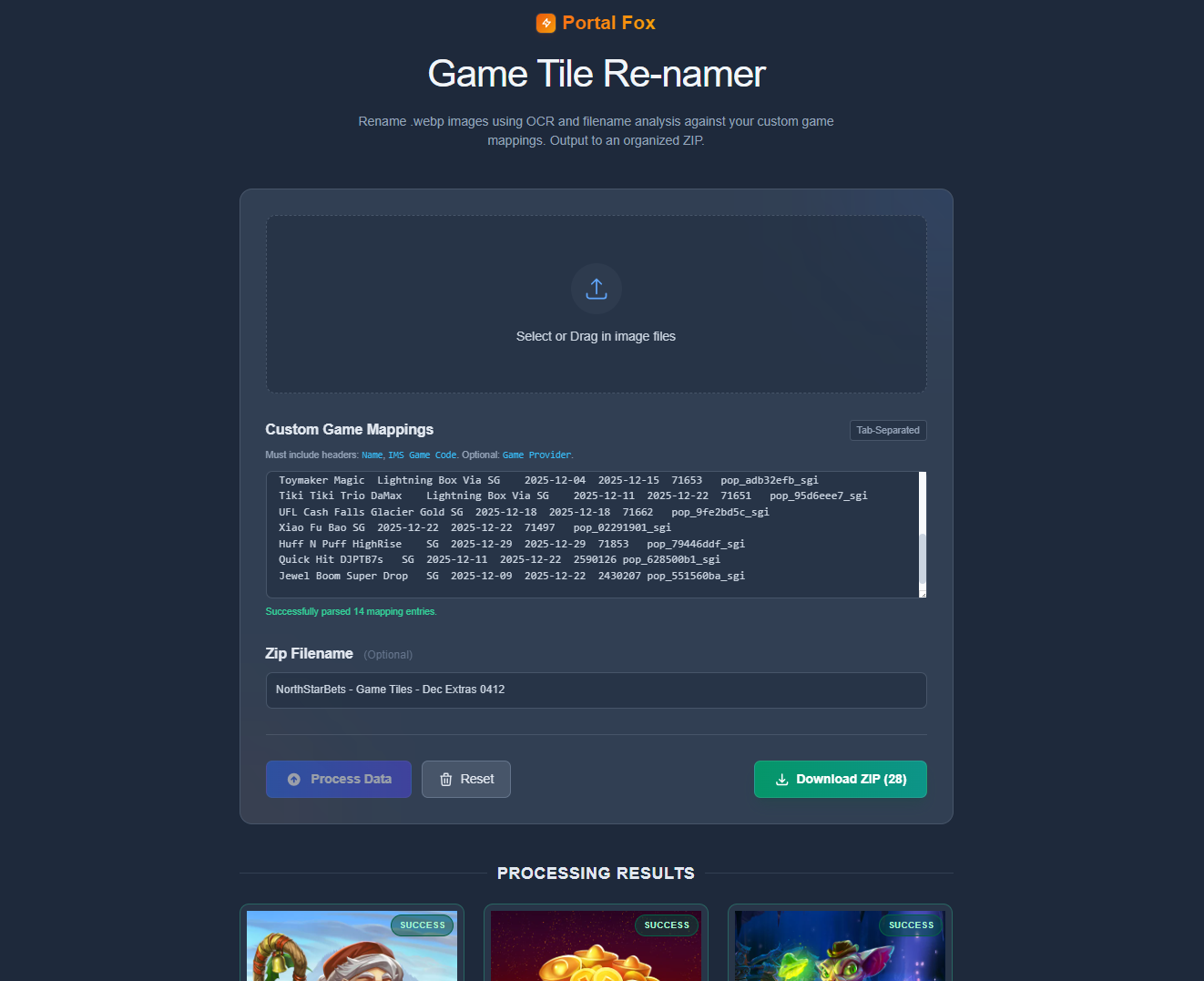
The underlying problem was a naming convention mismatch. The CMS required every uploaded asset to be named using the game's unique system code — but design teams naturally labelled files using the human-readable game title. Reconciling the two, looking up each game code, and renaming both portrait and square variants by hand was a significant and tedious bottleneck.
The Game Tile Renamer resolved this. Using OCR, the tool read the game title from each image file, cross-referenced it against the master game list to identify the correct system code, and batch-renamed all assets accordingly. It also handled both aspect ratio variants in a single pass. What had been a prolonged manual exercise became an automated step that completed in seconds — and having the correct game codes embedded in the filenames also streamlined the subsequent review and preview process.
Phase 4: Browser Automation via a Custom Chrome Extension
Once assets were uploaded and games were configured, each title still needed to be manually updated in the CMS post-testing: status set to live, Return to Player (RTP) percentage entered, and any applicable feature flags — such as Bonus Buy — toggled on.
This kind of repetitive in-browser work had historically been handled by macro automation tools. As those tools became unsupported, I built a custom Chrome extension to replace them. Drawing on the game codes produced in earlier stages, the extension automated the full update sequence across all games in a release batch — removing the need for any manual form interaction and ensuring consistency across every entry.
Phase 5: Eliminating Manual Certificate Processing
The final — and arguably most time-consuming — stage of the release process was one that is easy to overlook: regulatory certificate processing. Every new game required certificate data to be extracted from supplier PDFs and entered into the CMS manually. With multiple data points per document and a full batch of games per release, this task alone accounted for a substantial portion of the weekly workload.
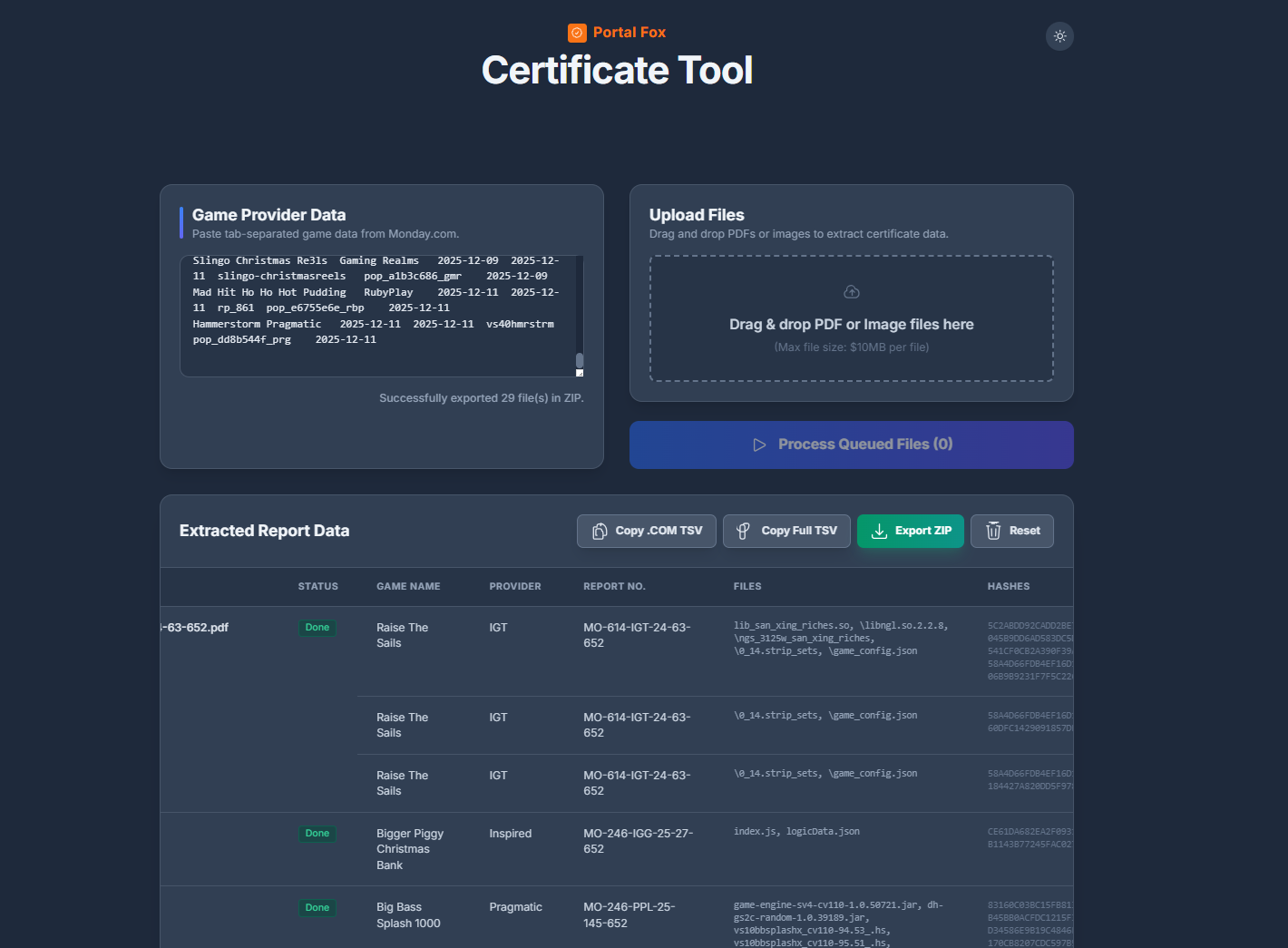
The Certificate Tool was built specifically to address this. Rather than opening each PDF and transcribing data field by field, the tool parsed the certificate documents automatically and mapped the relevant information directly into the required CMS format. The manual extraction process was eliminated entirely. This was the single biggest time saving across the entire pipeline — and it also removed a meaningful source of transcription error from the release process.
What Automation Actually Enables
Each tool delivered time savings in its own right. Together, they transformed a process that had occupied the better part of a working day into something that could be completed in a fraction of that time, with greater accuracy and less cognitive load.
More significantly, removing that overhead created space for work that is harder to systematise but far more valuable:
- Game Performance Analysis: Time previously absorbed by data entry could be redirected towards analysing player behaviour, evaluating game performance metrics, and making evidence-based decisions around lobby positioning and game weighting.
- Proactive Content Planning: With the release pipeline running reliably, it became possible to plan further ahead — coordinating with studios on upcoming titles, aligning launches with promotional calendars, and building campaigns around high-value player segments.
- Player Experience Optimisation: Attention could shift to the player journey itself: how games were surfaced, how recommendations performed, and how the overall portfolio was evolving relative to player preferences.
Conclusion
The tools described here are, individually, straightforward applications. What they represent collectively is something more meaningful: a deliberate effort to identify where skilled time is being lost to process, and to rebuild that process so it no longer requires it.
Automation is most valuable not when it replaces thinking, but when it removes the work that was preventing thinking from happening in the first place.